1. Executive Engineering Overview: The Physics and Kinematics of VFFS Packaging
In modern industrial packaging operations, the Vertical Form Fill Seal Machine (VFFS Machine) stands as the bedrock of high-efficiency, automated flexible packaging. Operating at the intersection of mechanical kinematics, pneumatic control, and precise thermal sealing dynamics, a VFFS machine converts a flat roll of flexible packaging film into a fully sealed, filled pouch in a continuous or intermittent vertical sequence.
Global procurement directors and plant operations managers evaluating a Vertical Form Fill Seal Machine face a complex engineering landscape. Understanding the core physics of vertical bag forming is vital to selecting equipment that delivers high Overall Equipment Effectiveness (OEE), minimal film giveaway, zero package seal leakage, and low Total Cost of Ownership (TCO).
Unlike horizontal flow wrappers or premade pouch fill-seal systems, a vertical form fill seal system utilizes gravity to assist product delivery directly into the newly formed film tube. This vertical kinetic path reduces transfer times, eliminates product bridging in delicate transfers, and minimizes footprint requirements on factory floors by up to 45% compared to horizontal lines.
1.1 Mechanical Sequence of a Standard VFFS Line
The automated operation of an industrial Vertical Form Fill Seal Machine proceeds through six synchronized electromechanical phases governed by a programmable logic controller (PLC):
- Film Unwinding and Tension Control: A continuous web of flexible film (BOPP, PET/AL/PE, Paper laminates, or mono-PE) is unwound from a reel. Motorized unwinds combined with dancer arms maintain constant web tension, preventing film distortion or optical sensor misalignment.
- Web Tracking and Registration: Precision photoelectric sensors (such as SICK eye-mark optics) track printed registration marks to ensure exact print alignment across every single pouch cut.
- Forming Shoulder Transformation: The flat film web is pulled over a stainless steel forming collar (forming shoulder). This kinematic geometry gently folds the flat web into a hollow cylindrical tube around a central vertical filling tube.
- Vertical Longitudinal Sealing: The overlapping edges of the film tube are fused vertically. This is accomplished either via continuous thermal sealing bars, heated belts, or impulse heating elements (creating a lap seal or fin seal).
- Dosing and Product Filling: As the vertical film tube advances, the precise product dose—metered by a volumetric cup, auger filler, multihead weigher, or liquid piston pump—is discharged down through the center of the forming tube into the sealed pouch bottom.
- Horizontal End Sealing and Cutting: Reciprocating or rotary horizontal sealing jaws clamp the film tube, creating the top seal of the filled bag and the bottom seal of the next bag simultaneously. An integrated pneumatic knife or cold serrated cutter severs the finished pouch.
1.2 Intermittent vs. Continuous Motion VFFS Machines
A critical architectural decision when specifying a Vertical Form Fill Seal Machine involves choosing between intermittent motion and continuous motion kinematics:
| Engineering Criterion | Intermittent Motion VFFS | Continuous Motion VFFS |
|---|---|---|
| Operational Motion | Film stops completely during horizontal jaw sealing | Film pulls continuously; sealing jaws move vertically with film |
| Speed Capacity (BPM) | 20 to 80 bags per minute | 80 to 220+ bags per minute |
| Ideal Product Application | Powders, free-flowing granules, single-dose sachets, pillow bags | High-speed snacks, potato chips, confectionery, high-volume commodities |
| Capital Expenditure (CAPEX) | Cost-effective, lower mechanical complexity | Higher investment, requires multi-axis servo synchronization |
| Film Compatibility | Extremely versatile (Thick laminates, foil, paper, mono-PE) | Requires high-speed heat-sealable films with narrow thermal windows |
| Turpack Recommended Model | Turpack VFFS Volumetric / Auger Series | Turpack Custom Continuous High-Speed VFFS Lines |
2. High-Performance Product Recommendations: Turpack VFFS & Portion Packaging Lines
Selecting the correct vertical form fill seal technology requires matching product rheology (powders, liquids, granules, solids) with the proper dosing mechanism. Turpack designs and builds CE-certified VFFS machines equipped with tier-1 global automation components.
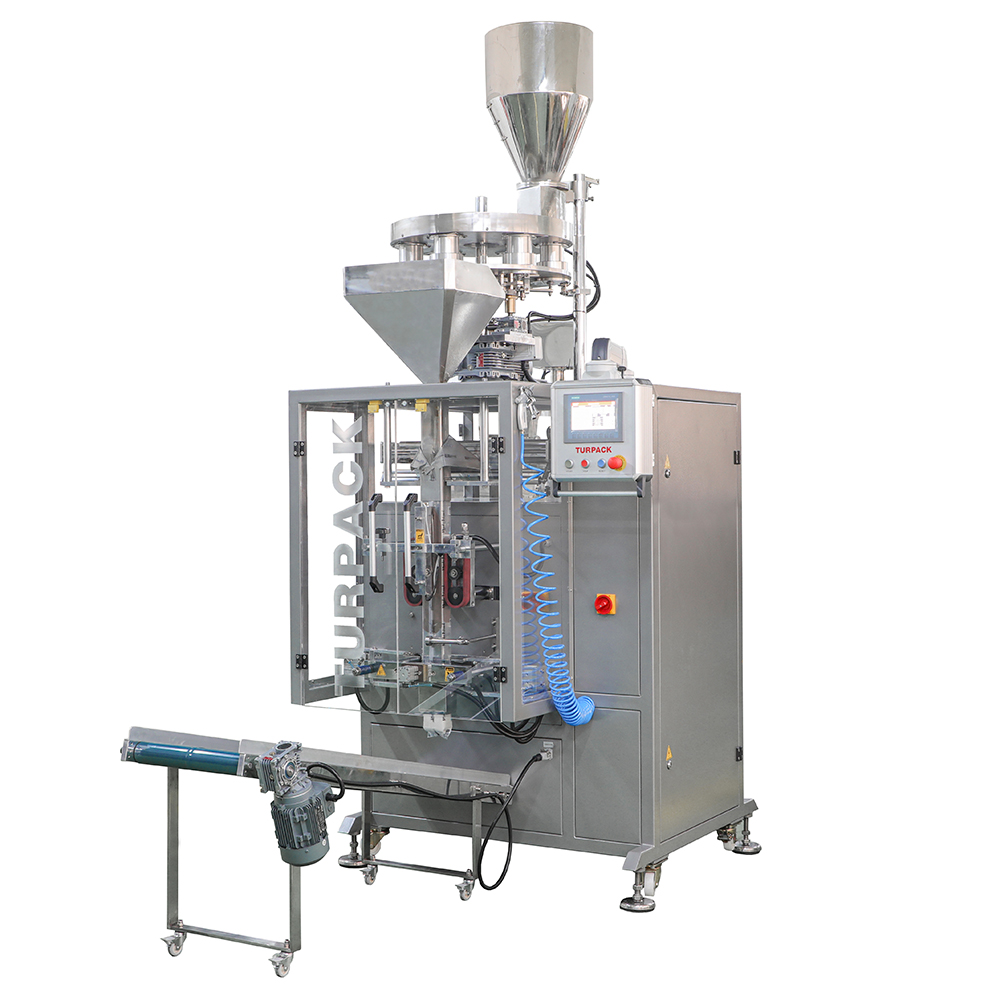
Volumetric Cup Dosing VFFS Machine
Engineered specifically for free-flowing granular products such as white sugar, salt, rice, lentils, seeds, and agricultural chemicals. Features telescopic volumetric dosing cups for instantaneous volume adjustment without tool changes.

Auger Dosing Powder VFFS Machine
Designed for non-free-flowing dusty powders including milk powder, flour, spices, nutritional supplements, and pharmaceutical formulations. Integrated servo-driven auger screw guarantees precision metering and dust-free filling.
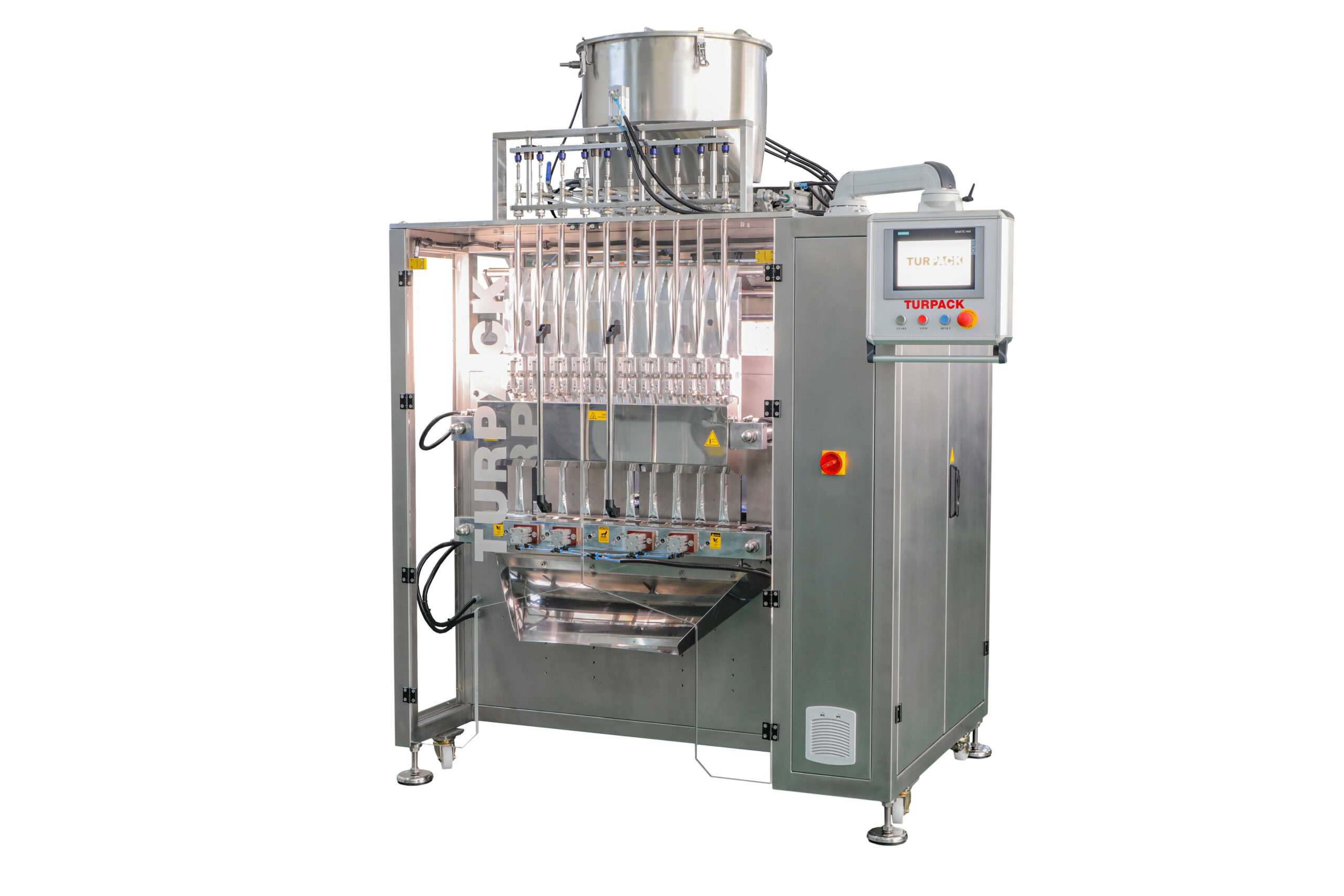
Multi-Lane Stick Pack VFFS Machine
High-density portion packaging machine outputting up to 12 lanes of stick packs simultaneously. Perfect for instant coffee, honey, liquid sauces, and pharma powders seeking minimum film waste and max output per square meter.
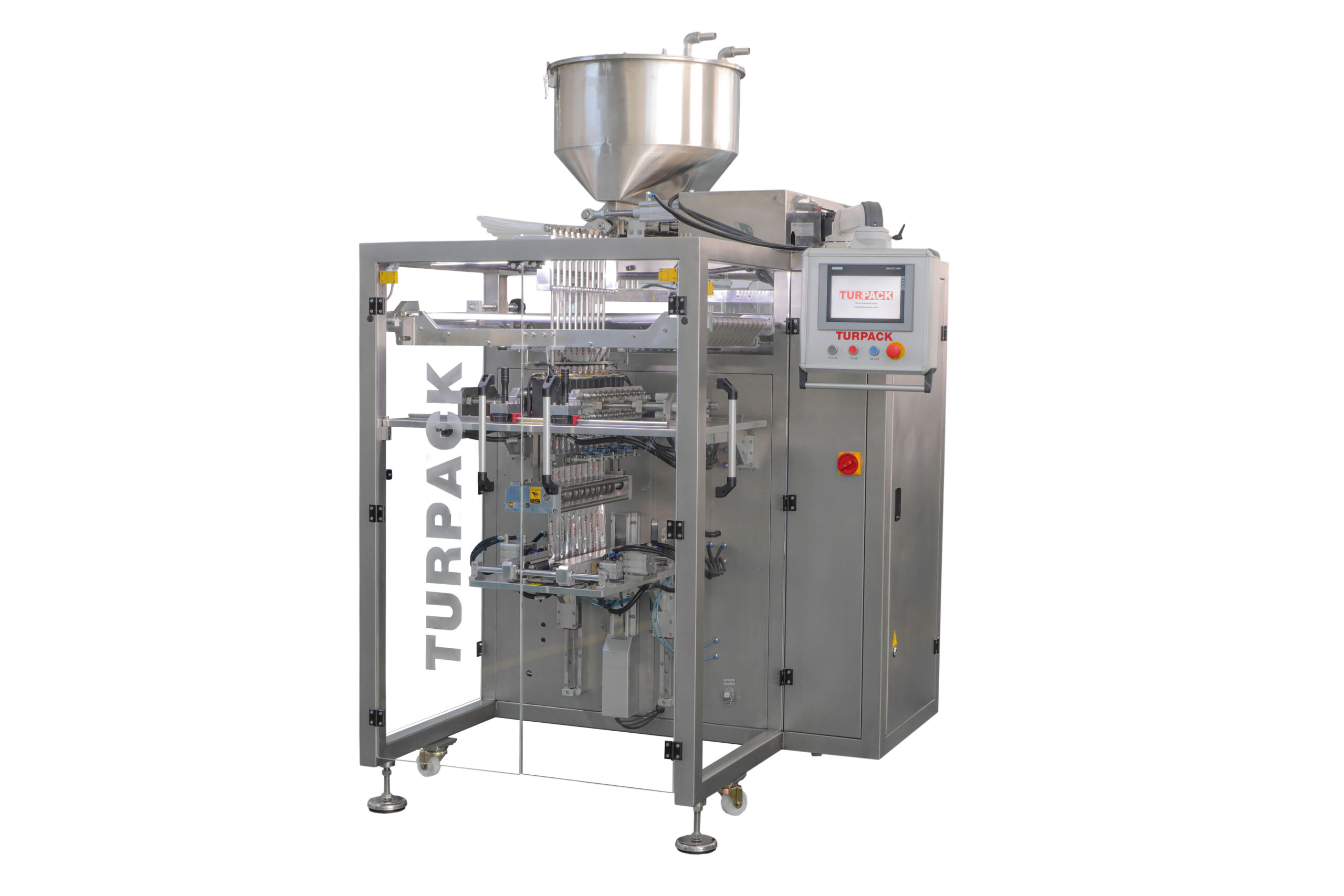
4-Side Seal Sachet Packaging Machine
Ideal for premium single-serve liquid condiments (ketchup, mayonnaise, olive oil), cosmetic lotions, and pharmaceuticals. Provides pristine 4-edge thermal seals with tear notches and high hermetic seal integrity.
3. Why Turpack? Engineering Excellence and Manufacturing Rigor
In global B2B machinery procurement, machine performance is only as reliable as the manufacturer behind it. Founded in 2005 in Istanbul, Turkey, Turpack Makine has established itself as Turkey's premier manufacturer and exporter of packaging equipment, serving clients across 95+ countries with over 1,100 machines installed worldwide.




3.1 Uncompromising Component Standard
Turpack refuses to compromise on electrical and mechanical architecture. Every Vertical Form Fill Seal Machine built in our factory incorporates standard non-proprietary components from industry leaders:
- Siemens PLC & Color Touchscreen HMIs: Providing intuitive recipe management, multi-language support, real-time diagnostic reporting, and PROFINET communication protocols.
- Kollmorgen Servo Motors & Drives: Precise multi-axis motion synchronization for film pulling belts and jaw sealing mechanisms, achieving sub-millimeter position accuracy.
- Festo Pneumatics: German-engineered pneumatic cylinders, valve manifolds, and air preparation units ensuring tens of millions of trouble-free cycles.
- SICK Sensor Technology: Reliable photo-eye sensors, contrast mark registration optics, and safety light curtains for operational security.
3.2 The Turpack 2-Year Comprehensive Full Warranty
While the industry standard for machinery warranty is typically 12 months with numerous exclusions, Turpack stands behind its craftsmanship with a 2-year full warranty covering mechanical, electronic, and pneumatic components. All machines manufactured carry full CE Certification and strictly adhere to ISO 9001:2015 quality management frameworks.
4. Future Technological & Industry Development Trends in VFFS Systems
The packaging automation landscape is undergoing rapid structural evolution driven by sustainability mandates, Industry 4.0 digitalization, and labor availability challenges. When investing in a new Vertical Form Fill Seal Machine today, procurement leaders must ensure their machinery platform is future-proofed against upcoming regulatory and market transitions.
4.1 Shift Toward Recyclable Mono-Material & Paper Laminates
Traditional flexible packaging relies heavily on multi-layer non-recyclable structures such as PET/AL/PE. Circular economy legislation worldwide is mandating a transition to mono-material polyolefins (Mono-PE, Mono-PP) and high-barrier paper-based substrates.
*Engineering Challenge:* Mono-materials exhibit extremely narrow thermal sealing windows and tend to stretch or burn under conventional constant-heat seal jaws.
*Turpack Solution:* Next-generation Turpack VFFS machines incorporate **precise PID electronic temperature control**, servo-modulated sealing jaw pressure profile dynamics, and rapid impulse sealing options to handle delicate mono-materials without film deformation or seal failure.
4.2 AI-Driven Edge Telemetry and Predictive Maintenance
Unplanned downtime on a primary packaging line can cost plant operators upwards of $5,000 per hour. Modern VFFS machines are evolving from standalone mechanical units into smart, connected IoT nodes:
- Real-Time OEE & Scrap Analytics: Live dashboard tracking of machine speed, cycle counts, thermal fluctuations, and target weight compliance.
- Predictive Component Wear Diagnostics: Vibration and current-draw monitoring on servo drives detect bearing wear or pneumatic valve degradation before catastrophic failure occurs.
- Remote AR Service Support: Secure VPN router integration (e.g., eWON / Siemens TeleService) enables Turpack field service engineers to troubleshoot PLC logic and adjust parameters globally in real time.
4.3 Rapid Toolless Format Changeover & Modular Ergonomics
With consumer brands introducing endless SKUs, fast batch turnarounds are mandatory. Modern VFFS machines feature quick-release forming tubes, click-in sealing jaw assemblies, and stored HMI digital recipes. Changeover times that previously took 45 minutes can now be achieved in under 10 minutes without specialized hand tools.
5. Global Buyer Procurement Trends: AI-Driven Intent and TCO Evaluation
Based on search intent data gathered across AI platforms (ChatGPT, Perplexity, Gemini) and global B2B procurement portals, enterprise buyers have shifted their evaluation metrics from simple upfront purchase price (CAPEX) to holistic Total Cost of Ownership (TCO) and supply chain resilience.
5.1 Why Nearshoring and Turkey Are Winning B2B Procurement Contracts
European and North American packaging buyers are actively diversifying their equipment supply chains away from far-east vendors due to unpredictable shipping costs, IP risks, and poor technical support responsiveness.
Turkey—and Turpack specifically—serves as an ideal manufacturing hub. Located at the crossroad of Europe, Asia, and the Middle East, Turpack provides European-quality engineering (utilizing Siemens, Festo, and SICK parts) at competitive capital investment points. Coupled with short transit times to Europe (3-5 days by road) and North America (12-14 days by sea), global buyers receive fast delivery and immediate local technical support.
5.2 Calculating True Total Cost of Ownership (TCO) for a VFFS Machine
When comparing VFFS quotes, seasoned procurement officers apply the following TCO equation:
TCO = CAPEX + (Downtime Loss × Rate) + (Film Waste Rate × Material Cost) + Utility Consumption + Maintenance/Spares Cost
By utilizing high-precision servo pulling belts (minimizing film waste by 1.5–3%), standard non-proprietary spare parts (reducing spare part replacement costs by 40%), and low energy consumption servo drives, Turpack VFFS machines achieve full CAPEX payback within 8 to 14 months of multi-shift operation.
6. Comprehensive B2B Technical FAQ: Answers to Buyer Questions
Below are expert responses to the top technical and commercial inquiries raised by enterprise packaging machine buyers:
Dosing system selection is dictated strictly by product bulk density, particle shape, and flow characteristics:
- Volumetric Cup Fillers: Best for free-flowing, consistent-density granules (granular sugar, table salt, rice, small seeds). Highly cost-effective, durable, and high-speed.
- Auger Fillers: Mandatory for non-free-flowing, compressible, or dusty powders (flour, cocoa, instant coffee, spice powders, pharmaceutical powders). Uses a servo-driven screw to precisely meter volume.
- Multihead Combination Weighers: Essential for non-uniform, fragile, or high-value discrete items (potato chips, nuts, frozen foods, candies, hardware). Measures weight via multiple weigh buckets to calculate exact target weight.
Film misregistration occurs when film tension fluctuates or optical eye-mark sensors misread printed registration marks. Leakages happen due to improper thermal jaw dwell time, uneven pressure across sealing bars, or product dust contaminating the seal area.
Turpack prevents these issues via: (1) Automatic web tracking optics by SICK; (2) Motorized unwind dancer arms that stabilize film tension; (3) Digital PID temperature regulators ensuring thermal stability within ±1°C; and (4) Optional dust extraction nozzles around the forming tube.
Yes. Bag width is determined by the diameter of the forming collar. By ordering additional interchangeable forming sets, you can run multiple bag widths on a single VFFS frame. Bag length is set digitally on the Siemens touchscreen panel in seconds. Furthermore, options for pillow bags, gusseted bags, or quad-seal bags can be integrated into the machine structure.
Turpack offers industry-leading production lead times, typically 4 to 8 weeks depending on machine customization. Every machine undergoes rigorous Factory Acceptance Testing (FAT) using the customer's actual product and film prior to shipment. After delivery, our technicians conduct remote or on-site commissioning, operator training, and lifetime technical support backed by guaranteed spare parts dispatch within 24–48 hours.
All Turpack VFFS machines strictly adhere to European Directives (Machinery Directive 2006/42/EC, Low Voltage Directive 2014/35/EU, and EMC Directive 2014/30/EU). Safety features include interlocked transparent safety guards, emergency stop circuits, dual-channel safety relays, and IP65-rated electrical cabinets.
7. Partner with Turpack for Your Packaging Automation Line
Whether you are setting up a high-speed sugar packing facility, launching a new powder supplement line, or upgrading your existing food packaging plant, Turpack delivers the engineering precision, component quality, and long-term reliability your business demands.
Download our comprehensive product catalog, request a customized technical quotation, or consult directly with our senior application engineers today.
Accelerate Your Production Line Efficiency
Get instant access to detailed machine specifications, 3D layouts, videos, and competitive factory-direct pricing.