1. Strategic Shift to Multi-Lane Stick Pack Packaging Machinery
The global single-serve packaging sector is undergoing a rapid transition toward flexible, material-efficient, and consumer-friendly formats. Among these, the Stick Pack Packaging Machine has established itself as the gold standard for portion-controlled dose delivery across pharmaceutical, nutraceutical, food and beverage, and cosmetic industries. Characterized by its tubular geometry, longitudinal fin or lap seal, and dual transverse seals, the stick pack delivers up to 40% film consumption savings compared to traditional four-side seal sachets of equivalent volume.
For industrial buyers evaluating automated machinery, selecting the optimal multi-lane stick pack filler requires analyzing mechanical kinematic profiles, dosing precision dynamics, roll stock film handling mechanics, thermal sealing behavior, and integration capabilities for downstream cartoning. As global production demands lean efficiency and minimal scrap rates, understanding the core engineering parameters of stickpack equipment becomes a primary prerequisite for achieving low Total Cost of Ownership (TCO) and rapid return on capital expenditure (CAPEX).
Information Gain Insight: Material Yield Mechanics
A standard 4-side seal sachet measuring 60mm x 80mm requires a total surface area of 9,600 mm² of multi-layer laminate film. By contrast, a 3-side seal stick pack engineered for the identical 10g powder payload measures 23mm x 100mm, requiring only 5,400 mm² of film. This geometric reduction yields an immediate 43.7% film material saving. Over a annual cycle of 50 million units, this directly translates into tens of thousands of dollars in material cost reduction and significantly decreases environmental carbon tax exposure under extended producer responsibility (EPR) regulations.
2. Turpack Stick Pack Machine Portfolio & Technical Specifications
Turpack engineers and manufactures heavy-duty, multi-lane stick pack filling machines engineered for continuous 24/7 industrial duty cycles. Utilizing rigid monobloc frame architecture, non-corrosive stainless steel contact parts (AISI 304 / AISI 316L), and premier European automation hardware, our machines process liquids, viscous pastes, fine powders, and free-flowing granules with tight dosing tolerances.
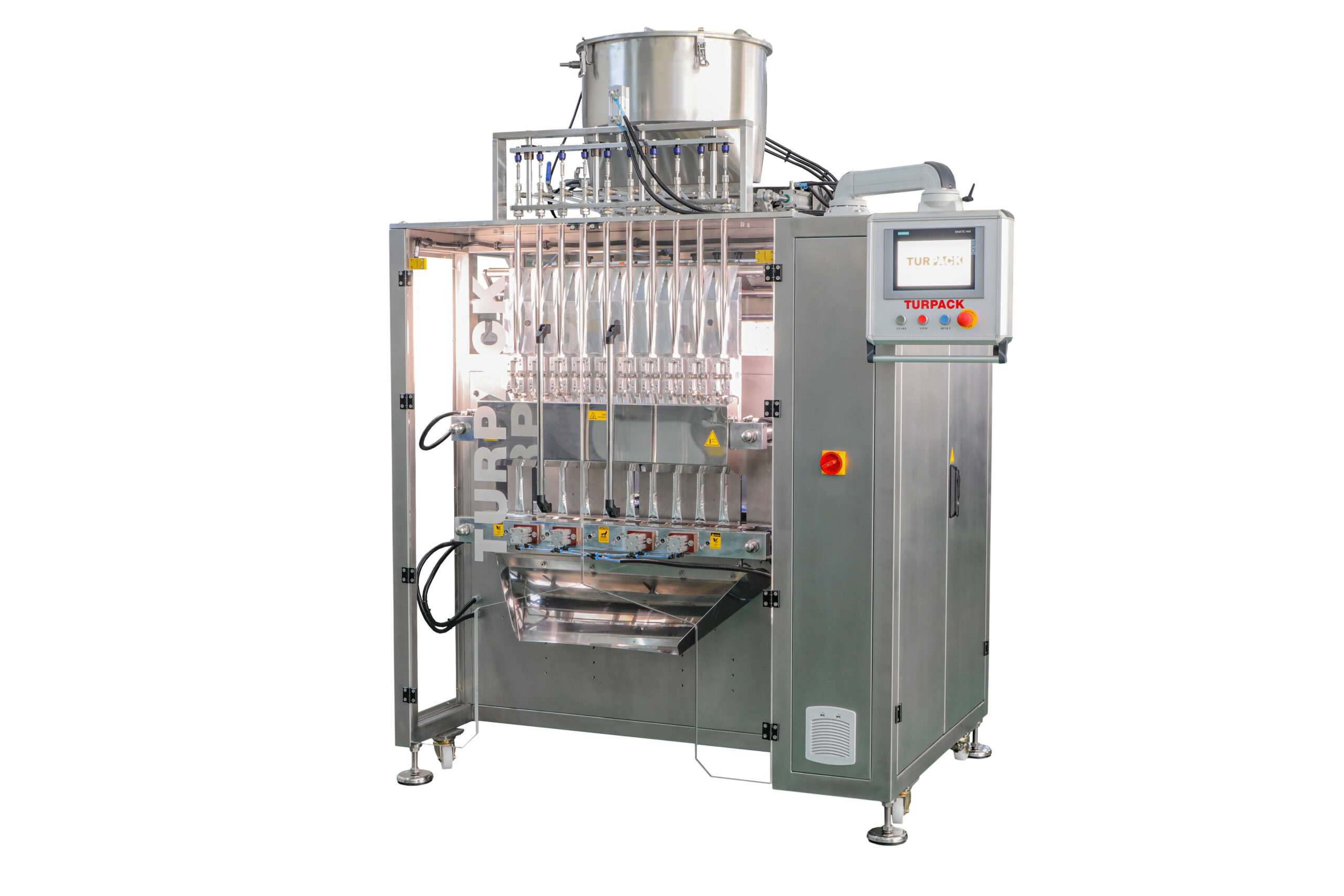
Multi-Lane Powder Stick Pack Machine
Engineered for instant coffee, collagen peptides, pharmaceutical powders, and protein formulas. Equipped with individual servo-driven auger screws per lane for exact gravimetric accuracy.
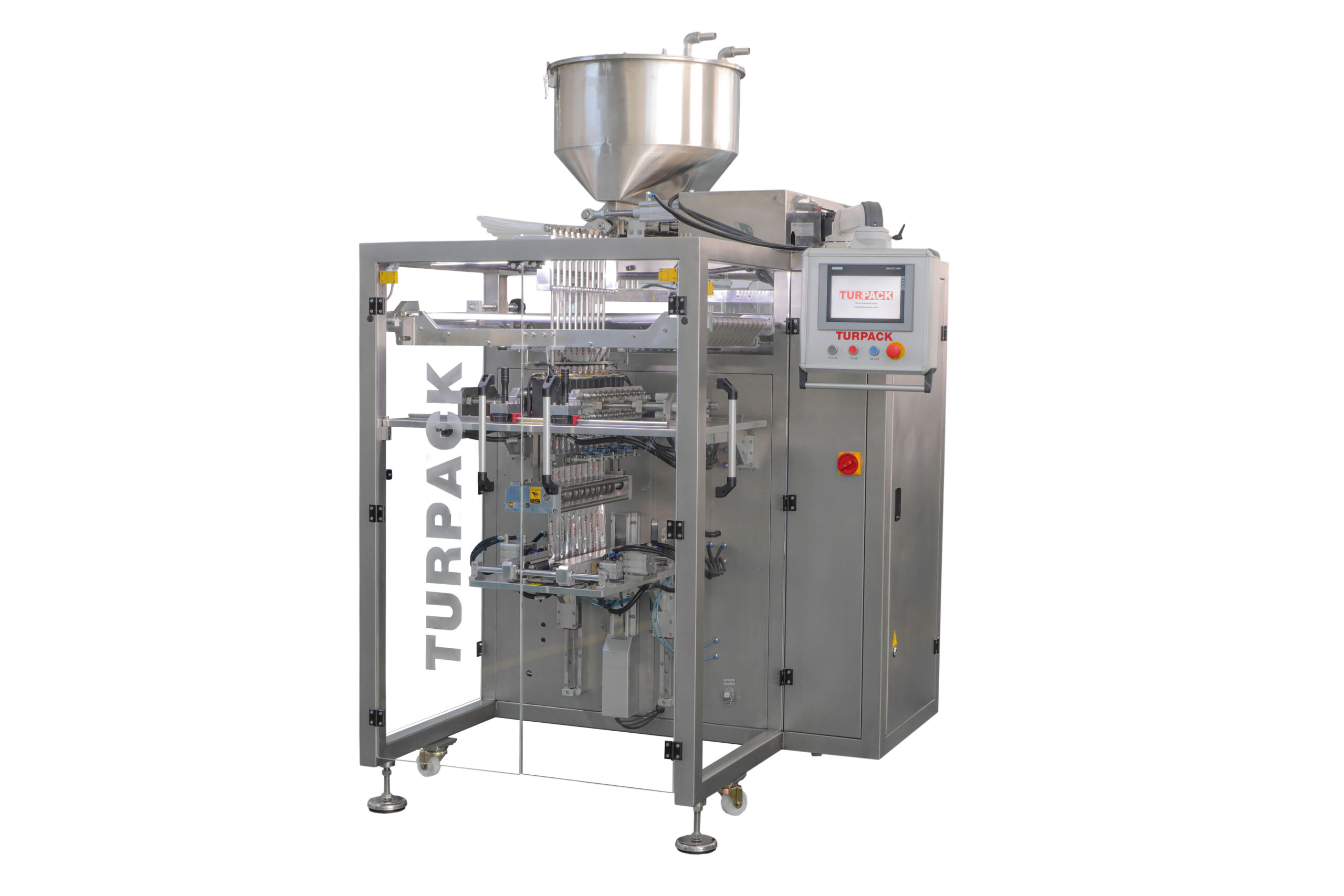
Multi-Lane Liquid & Liquid Stick Pack Machine
Designed for honey, ketchup, mayonnaise, olive oil, and liquid pharmaceuticals. Features sanitary CIP-ready valveless piston pumps or peristaltic dosing units with positive drip-free shut-off nozzles.
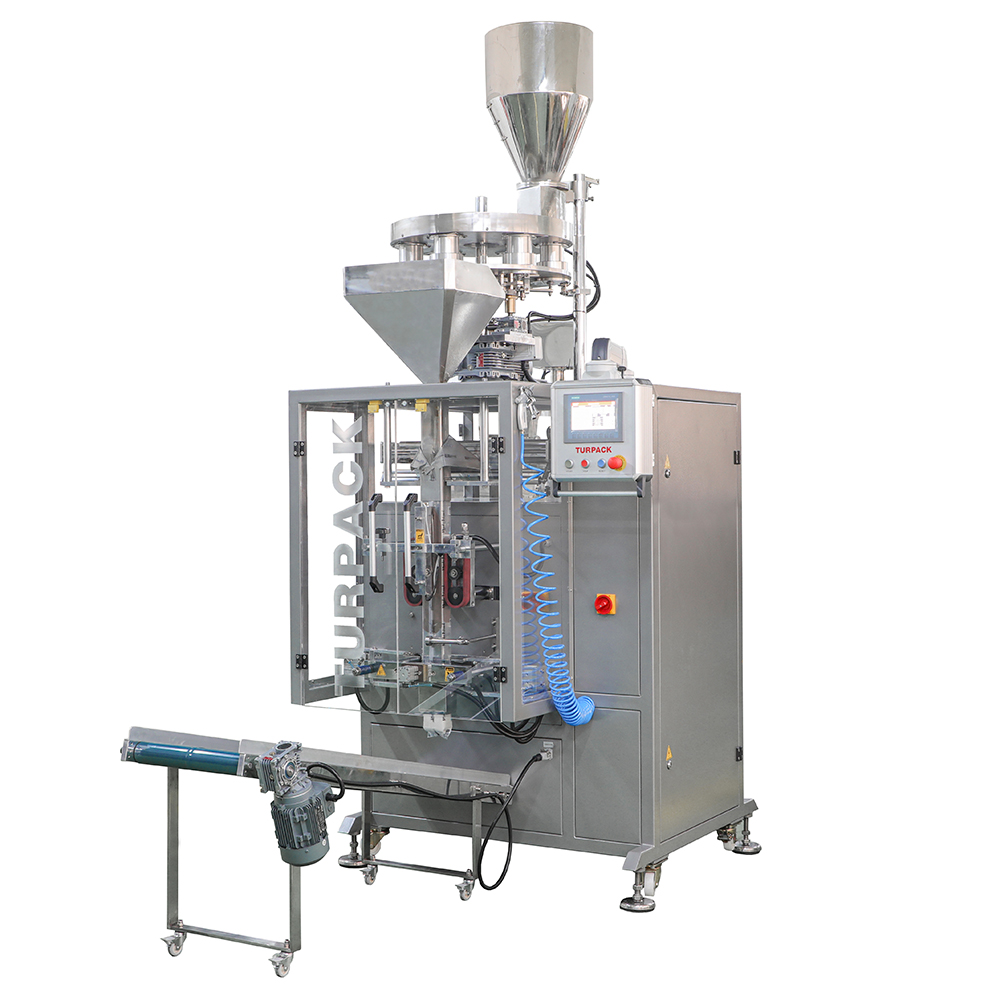
Granular & Free-Flowing Stick Pack Line
Optimized for white sugar, salt, black pepper, and agricultural granules. Employs precision micro-adjustable volumetric cup dosing for high-speed linear filling up to 80 cycles per minute.
Technical Performance Matrix
The following engineering data table outlines the operational parameters across our standardized multi-lane stick pack packaging machine configurations:
| Specification Parameter | 4-Lane Stickpack Line | 6-Lane Stickpack Line | 8-Lane Stickpack Line | 10-12 Lane Ultra-High Line |
|---|---|---|---|---|
| Target Product State | Powder / Liquid / Granule | Powder / Liquid / Granule | Powder / Granule / Liquid | Fine Granules / Powders |
| Maximum Output Speed | 160 - 200 sticks/min | 240 - 300 sticks/min | 320 - 400 sticks/min | 480 - 600 sticks/min |
| Stick Width Range | 17 mm - 40 mm | 17 mm - 35 mm | 17 mm - 30 mm | 15 mm - 25 mm |
| Stick Length Range | 50 mm - 200 mm | 50 mm - 180 mm | 50 mm - 160 mm | 50 mm - 150 mm |
| Dosing Precision Tolerance | ± 0.5% to ± 1.5% | ± 0.5% to ± 1.5% | ± 0.8% to ± 1.5% | ± 1.0% to ± 2.0% |
| Primary Motion Control | Kollmorgen Servo Drive | Kollmorgen Servo Drive | Kollmorgen Servo Drive | Kollmorgen Multi-Axis Servo |
| System Automation PLC | Siemens S7-1200 / 1500 | Siemens S7-1500 Motion | Siemens S7-1500 Motion | Siemens S7-1500 T-CPU |
| Pneumatic Subsystems | Festo Valve Terminals | Festo Valve Terminals | Festo Valve Terminals | Festo Valve Terminals |
| Construction Grade | AISI 304 Frame / 316 Contact | AISI 304 Frame / 316 Contact | AISI 304 Frame / 316 Contact | Full AISI 316 Sanitary Option |
3. Component Engineering & Manufacturing Excellence
In accordance with global industrial standards, operational reliability depends directly on the quality of hardware components. Turpack avoids proprietary, closed-source sub-assemblies. Every stick pack packaging machine is built using universally accessible, premium European components to guarantee immediate availability of spare parts worldwide:
- Programmable Logic Controllers (PLC) & HMI: Integrated Siemens S7-1500 series controllers with multi-color widescreen touch interfaces enable recipe management, real-time diagnostic logging, and Industry 4.0 OPC-UA server telemetry integration.
- Motion Systems & Servo Technology: Kollmorgen direct-drive brushless servo motors govern film pull wheels and sealing jaw kinematics, maintaining positional accuracy down to 0.01 mm under high dynamic loads.
- Pneumatic Actuation: Festo pneumatic cylinders and modular valve manifolds deliver consistent clamping force and rapid response times across cross-seal and slitting assemblies.
- Optical & Registration Sensors: SICK photo-electric eye sensors ensure registration print tracking across heat-sealable laminated films, eliminating drift across 12 simultaneous lanes.
Need a custom engineering configuration or volumetric calculator for your product line?
Contact Us4. Global Buyer Intent & Technical Engineering FAQ
Below are detailed technical answers to the most frequent engineering and procurement inquiries submitted by global plant managers, project engineers, and buyers evaluating stick pack packaging lines.
Multi-lane stick pack machines pull a single wide roll of laminated film stock, which is continuously slit into individual ribbons by a bank of rotary blades. If tension varies across the web width, film skew occurs, causing uneven stick lengths and improper seal alignment. Turpack addresses this through a dual-stage dancer bar system coupled with an pneumatic continuous unwinding braking sensor. Each slitting lane features individual micro-adjustable guide channels and independent slitting knife holders. Additionally, servo-driven main draw rollers utilize precision-ground vulcanized rubber sleeves that exert uniform radial contact pressure, eliminating micro-slippage across outer versus central lanes.
Product physical characteristics dictate dosing system design:
- Cohesive Powders (e.g., milk powder, whey protein, pharmaceutical actives): Require a vertical servo-driven auger system featuring independent auger screws for each lane. Agitator blades inside the main hopper continuously break bridging tendencies, while variable speed servo profiles ensure consistent bulk density compaction within the screw flights.
- Free-Flowing Granules (e.g., sugar, salt): Utilize micro-adjustable volumetric cup systems where volume is altered mechanically or digitally without dismantling tooling.
- Hygroscopic or Viscous Liquids (e.g., honey, ketchup, liquid gel): Require rotary valveless piston pumps or pneumatic positive-displacement pumps equipped with heated hopper jackets, agitation units, and anti-drip cut-off nozzles (suck-back valves) to prevent seal area contamination.
From an initial CAPEX perspective, a multi-lane stick pack machine requires slightly higher precision machining due to the slitting and former assembly complexity compared to a flat sachet machine. However, from a Total Cost of Ownership (TCO) perspective, stick pack machines offer superior long-term economics:
- Film Reduction: Stick packs require up to 40% less film material per unit volume. For high-volume producers, film cost savings frequently amortize the machinery cost difference within 8 to 14 months.
- Cartoning Efficiency: The slender form factor allows stick packs to pack densely into secondary cartons, reducing secondary packaging volume, outer shipping container costs, and freight shipping expense by up to 25%.
- Consumer Usability: Stick packs offer a narrow spout design ideal for pouring directly into narrow water bottle openings, enhancing brand value.
Seal channel leaks occur when the inner seal polymer layer (such as PE or CPP) fails to reach its melt flow temperature, or when excessive thermal energy degrades the barrier layer (such as PET or Foil). Turpack stick pack machines employ individual PID temperature control loops for each heating element within the vertical and horizontal sealing jaws. Combined with solid-state relays (SSR) and internal thermocouple feedback, thermal fluctuation is constrained within ±1°C of the setpoint. Sealing jaw geometry is custom-ground with serrated, line, or flat patterns matching the specific micron thickness and layer structure of the buyer's barrier film.
For pharmaceutical applications (such as oral rehydration salts, active powders, or liquid suspensions), Turpack constructs machinery adhering to cGMP and FDA guidelines. All product contact zones are fabricated from electro-polished AISI 316L stainless steel with surface roughness (Ra) values below 0.8 µm. Drive mechanics are completely isolated from product areas via sealed sanitary partitions. We supply comprehensive validation documentation packages, including Installation Qualification (IQ), Operational Qualification (OQ), Factory Acceptance Testing (FAT), and Site Acceptance Testing (SAT) protocols to streamline customer regulatory approval.
Yes. Modern sustainable packaging initiatives mandate transitions from multi-layer aluminum laminates to recyclable monomaterial structures (e.g., Mono-PE or Mono-PP). Monomaterial films possess narrow thermal sealing windows and are prone to stretching under thermal load. Turpack machines incorporate servo-controlled sealing jaw dwell-time adjustments, constant-tension servo unwind stands, and specialized low-friction former tubes to process recyclable monomaterial films without stretch distortion or film burn-through.
For oxygen-sensitive powders such as baby formula, probiotics, or instant coffee, oxidation degrades product shelf life. Turpack stick pack equipment integrates specialized multi-point Modified Atmosphere Packaging (MAP) nitrogen injection lances directly into the forming tubes and product dosing drop zone. By maintaining a positive-pressure nitrogen blanket within the filling manifold, residual oxygen levels inside the sealed stick pack can be consistently reduced below 1.5% to 2.0%, depending on film barrier quality and product bulk porosity.
5. Procurement Trends & Future Technological Developments
As contract packagers and enterprise manufacturers plan capital investments for the coming decade (2026–2035), several dominant technology shifts are defining the next generation of stick pack packaging machinery:
A. Integration of AI-Driven Predictive Maintenance & Condition Monitoring
Modern stickpack operations are shifting away from reactive maintenance schedules. Next-generation Turpack machinery incorporates vibration sensors on main servo drive gearboxes, thermal imaging monitors on sealing jaws, and pneumatic pressure transducers. This continuous telemetry feed is evaluated via edge-computing algorithms to alert plant technicians to bearing wear, heater rod degradation, or pneumatic valve leakage hours before operational downtime occurs.
B. Dynamic Digital Changeover & Toolless Adjustments
Batch sizes in contract packaging are shrinking while SKU variations are increasing. To minimize downtime during product swaps, future procurement specifications favor stick pack machines with digital motorized lane positioning, toolless quick-release former assemblies, and automated CIP (Clean-in-Place) fluid flushes for liquid lines. This reduces changeover times from hours down to under 30 minutes.
C. High-Speed Secondary Packaging Synchronization
Standalone stick pack machines are increasingly integrated directly into fully automated primary-to-secondary packaging cells. Turpack stick pack lines connect seamlessly via robotic pick-and-place transfer units or high-speed indexing bucket conveyors to downstream cartoning systems, flow wrappers, and case packers. Integrated vision control cameras inspect every stick for correct print registration, fill height, and seal integrity, automatically ejecting defective sticks at line speed prior to cartoning.
6. Why Partner with Turpack: Engineering Authority & Enterprise Support
Selecting a machinery manufacturing partner requires evaluating engineering heritage, manufacturing capacity, quality control infrastructure, and global service capabilities. Established in 2005 in Istanbul, Turkey, Turpack has delivered over 1,100 packaging machines to buyers across 95+ countries.
Rigorous Quality Certification
All operations adhere strictly to ISO 9001:2015 quality management procedures. Every stick pack packaging machine is CE marked, fully compliant with European Low Voltage and Machinery Directives (2006/42/EC).
2-Year Comprehensive Warranty
We back our engineering precision with an industry-leading 2-year full warranty covering mechanical structures, servo drives, PLC modules, and pneumatic assemblies — supported by worldwide field technicians.
Whether you require a single 4-lane stick pack filler for a pilot facility or a complete multi-line automated packaging plant integrated with high-speed cartoners, Turpack delivers engineered accuracy, on-time manufacturing schedules, and direct factory support.
Request Your Customized Stick Pack Machine Proposal
Consult directly with our senior application engineers to evaluate product samples, determine volumetric dosing parameters, calculate film yield savings, and receive a complete turnkey quotation within 24 hours.