Executive Summary: High-Precision Salt Portion Packaging
In the modern fast-food, catering, airline, and hospitality industries, single-serve portion packaging has transformed consumer convenience and food hygiene. Among all condiment formats, the salt stickpack (narrow tubular pouch) has rapidly surpassed traditional flat 4-side seal sachets due to its superior ergonomic design, 40% reduction in packaging film usage, and effortless pour-dispensing.
However, automating the dosage and vertical form fill seal packaging of table salt (sodium chloride) presents severe mechanical and operational challenges. Salt crystals are inherently abrasive, highly hygroscopic (moisture-absorbing), prone to static electricity buildup, and aggressive against standard industrial metals. Purchasing a generic powder or granule stick pack machine often leads to catastrophic corrosion of dosing cups, film seal failure caused by micro-dust entrapment, and premature mechanical wear within months of installation.
As a global leader in portion packaging machinery with over 20 years of manufacturing experience in Istanbul, Turkey, Turpack designs specialized multi-lane Salt Stickpack Machines specifically built to overcome these chemical and mechanical hurdles. Exported to over 95 countries, Turpack salt packaging machinery integrates premium European automation components, heavy-duty anti-corrosive metallurgy, and clean zero-dust sealing technologies.
Information Gain: Why Metallurgy Matters in Salt Packaging
Standard packaging machinery manufacturers frequently utilize AISI 304 grade stainless steel for food contact areas. Under ambient plant humidity, sodium chloride micro-dust reacts with oxygen to break down AISI 304's passive chromium oxide layer, leading to severe pitting corrosion and metal contamination. Turpack salt stickpack machines mandate AISI 316L stainless steel infused with molybdenum for all product contact hoppers, telescopic cups, and dosing tubes, providing total chemical immunity against salt oxidation.

Figure 1: High-Speed Multi-Lane Salt Stickpack Portion Packaging Solution by Turpack.
Technical Deep-Dive: Engineering Challenges & Turpack Innovations
Global procurement directors and project engineers evaluating salt packaging equipment must look beyond basic speed metrics (PPM). The true cost of ownership (TCO) is determined by machine uptime, volumetric dosing consistency, seal integrity, and corrosion resistance. Below is an engineering overview of how Turpack solves the core physical challenges of salt stickpack automation:
1. Volumetric Cup Dosing vs. Salt Crystal Degradation
Salt cannot be accurately or economically dosed using auger screws because rotating metal auger flutes grind delicate sea salt or mineral salt crystals into fine dust, causing bulk density variations and static cling. Turpack utilizes custom-engineered telescopic volumetric cup dosing systems. Each lane features an individually calibrated micro-cup milled from anti-static, food-grade synthetic polymer or AISI 316L steel. As the dosing plate rotates, salt falls freely under gravity into the formed film tube without physical friction or crystal degradation.
2. Active Salt Dust Containment & Sealing Jaw Protection
During high-speed filling (up to 70 strokes per minute), salt micro-dust suspended inside the forming tube can settle on the heat-sealing margins of the flexible film. When horizontal or vertical sealing jaws compress over salt particles, the seal polymer fails to fuse, resulting in leaking stickpacks and atmospheric moisture ingress during storage. Turpack integrates dynamic vacuum dust-extraction hoods directly above the top sealing assembly and applies anti-static Teflon coatings to all vertical drop chutes, ensuring 100% airtight seals on every stick.
3. Precision Multi-Lane Synchronized Motion
A multi-lane salt stickpack machine operates with anywhere from 4 to 12 parallel filling lanes from a single master film reel. Turpack utilizes Kollmorgen servo motor drives and Siemens S7-1500 PLC platforms to govern film slitting, tube forming, vertical sealing, dosing shot timing, and guillotine cutting. Synchronized optical sensor registration (SICK photo-eyes) guarantees perfect print centering across all lanes simultaneously.
Turpack Salt Stickpack Machine Technical Comparison
Select the optimal machinery configuration based on your factory production target and facility layout:
| Specification / Model | ST400-Salt (4 Lanes) | ST800-Salt (8 Lanes) | ST1200-Salt (12 Lanes) |
|---|---|---|---|
| Production Capacity | 160 - 240 sticks/min | 350 - 500 sticks/min | 550 - 720 sticks/min |
| Dosing Range | 0.2g to 5.0g per stick | 0.2g to 5.0g per stick | 0.2g to 5.0g per stick |
| Stick Width Range | 15mm to 35mm | 15mm to 35mm | 15mm to 30mm |
| Contact Metallurgy | AISI 316L Stainless Steel | AISI 316L Stainless Steel | AISI 316L Stainless Steel |
| Dosing Mechanism | Telescopic Volumetric Cups | Servo Volumetric Cups | Servo Volumetric Cups |
| Control System | Siemens PLC & Touchscreen | Siemens PLC & Touchscreen | Siemens Motion Control PLC |
| Pneumatics System | Festo Germany | Festo Germany | Festo Germany |
| Power Consumption | 4.5 kW | 8.5 kW | 12.0 kW |
| Target Applications | Regional caterers, small plants | Industrial salt processors | Global high-volume co-packers |
Turpack Salt Packaging Machinery Portfolio & Recommendations
Depending on your automation footprint and downstream cartoning requirements, Turpack provides standardized and customized salt packaging machinery lines:
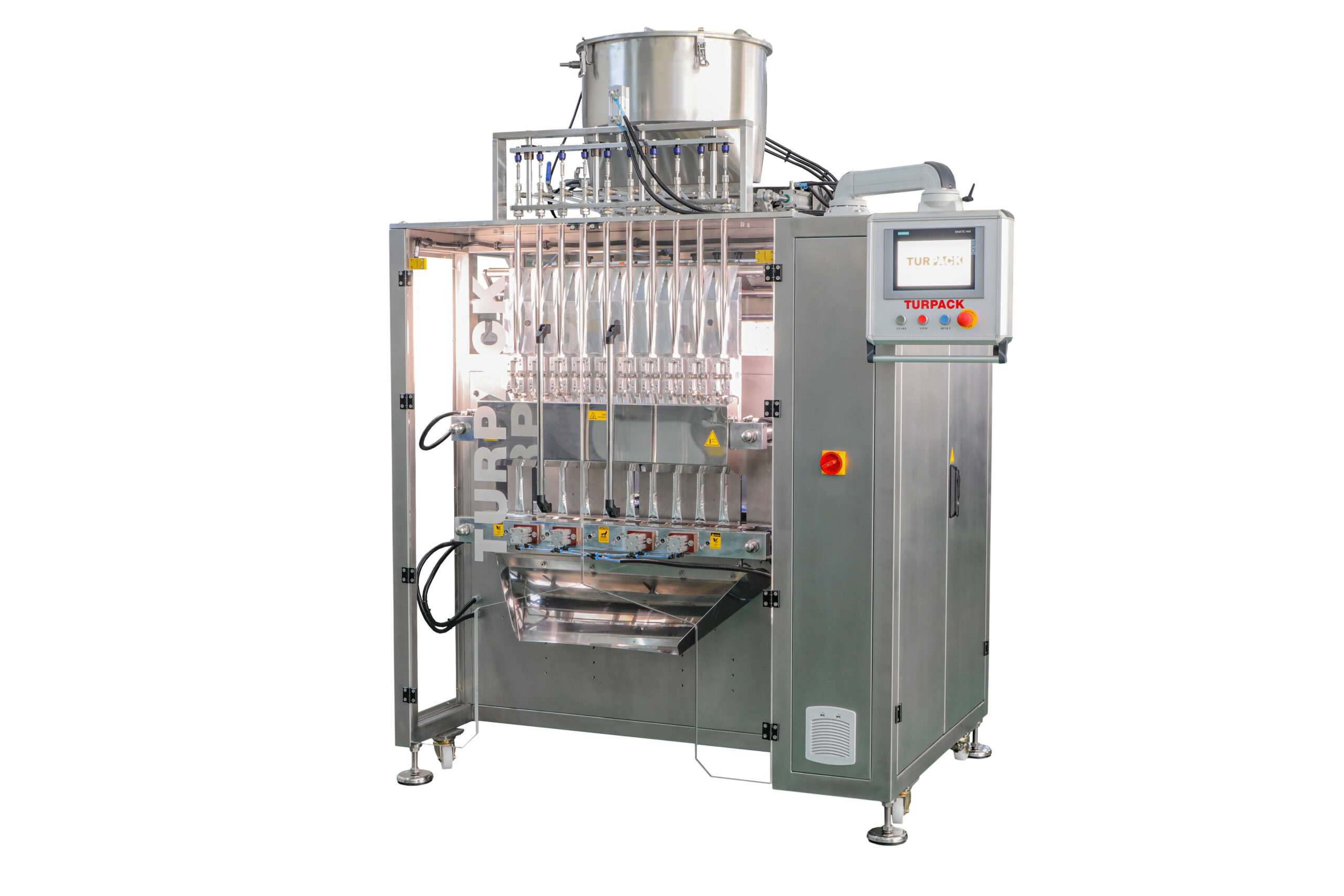
- 8-Lane high-speed execution (up to 500 PPM)
- Toolless volumetric cup adjustment for dose changes
- Integrated SICK optical registration eye
- Compact footprint with full safety enclosures
- Dual hopper setup for simultaneous salt & pepper packing
- Automated collating & secondary pouching integration
- AISI 316L anti-corrosive stainless contact zones
- Siemens HMI recipe storage for 50+ product profiles
Future Procurement Trends in Salt & Condiment Portion Packaging
Procurement teams within global food manufacturing and contract packaging companies are navigating dramatic shifts in retail demand, environmental legislation, and industrial automation. When sourcing a Salt Stickpack Machine for 2026 and beyond, project leaders should align their equipment specifications with the following macro trends:
1. Eco-Friendly & Monomaterial Barrier Films
Traditional stickpack packaging relies on multi-layer laminates (e.g., PET/ALU/PE) that are difficult to recycle. Global legislation is pushing fast toward recyclable paper-based laminates and monomaterial polyolefins (PE/PE or PP/PP). However, paper films exhibit lower elasticity and require precise temperature and sealing pressure control. Turpack salt stickpack machines are engineered with independent PID temperature control loops on every sealing jaw, enabling seamless transition between traditional foil laminates and eco-friendly recyclable paper barrier films without pouch tearing.
2. Micro-Portioning & Sodium Reduction Trends
Consumer health initiatives are driving food brands toward smaller, precise single-dose salt allocations (e.g., reducing standard 1.0g sticks to 0.7g or 0.5g). Dosing micro-quantities at speeds exceeding 60 cycles per minute demands extreme mechanical precision. Turpack’s micrometric volumetric dosing plates allow operators to fine-tune cup depth down to 0.01mm via HMI touchscreens, ensuring absolute dosing uniformity across all production lanes.
3. Industry 4.0 Telemetry & Remote Predictive Maintenance
Modern production facilities cannot afford unexpected downtime. Turpack salt stickpack lines feature optional Siemens MindSphere IoT gateways. Factory managers can monitor real-time Overall Equipment Effectiveness (OEE), track daily stick counts, monitor motor thermals, and receive automated maintenance alerts on mobile devices. Remote VPN connectivity enables Turpack field engineers in Turkey to diagnose control logic parameters instantly anywhere in the world.
Industry & Technological Development Trends
The machinery market for portion packaging is transitioning rapidly from simple mechanical drive systems to fully electronic, servo-driven architectures. Below are the key technological advancements benchmarked by Turpack:
- Direct Servo Motion Control: Replacement of mechanical cams and chains with independent Kollmorgen servo motors for film pulling, horizontal sealing jaws, and volumetric cup alignment. This eliminates mechanical backlash, reduces noise below 72 dB, and eliminates greasing requirements near food contact areas.
- Laser Scoring & Easy-Tear Notch Modules: Integrating laser perforation units directly into the multi-lane slitting section. This creates a clean tear-line on the stickpack, preventing consumer frustration and accidental salt spills upon opening.
- Checkweighing & Automated Feedback Loops: Integrating multi-lane dynamic checkweighers downstream. If an individual lane deviates from target weight parameters, the Siemens PLC automatically adjusts the motorized volumetric cup plate for that specific lane in real-time.
Enterprise Advantages: Why Global Buyers Trust Turpack
Selecting a packaging machine manufacturer requires evaluating long-term technical support, quality management standards, and manufacturing integrity. Here is why Turpack stands out as Turkey's premier packaging machine exporter:




- 20+ Years of Focused Engineering Expertise: Since 2005, Turpack has concentrated exclusively on flexible portion packaging machines, delivering over 1,100 machines to clients in 95+ countries worldwide.
- Tier-1 World-Class Components: We never compromise on component quality. Every salt stickpack machine incorporates Siemens PLCs & touchscreens, Festo pneumatics, SICK sensors, and Schneider/Kollmorgen electrics. This guarantees global spare parts availability at any local industrial supplier.
- Unmatched 2-Year Comprehensive Warranty: While standard industry warranties span only 12 months, Turpack backs every machine with a 2-Year Full Warranty covering mechanical, electronic, and pneumatic components.
- ISO 9001 & CE Certification: Our modern manufacturing facility in Istanbul operates under ISO 9001 quality management protocols. All machines carry full CE safety compliance certificates.
- Fastest Production Delivery Times: Thanks to standardized modular engineering and extensive component inventory, Turpack offers industry-leading production delivery timelines, ensuring your plant goes operational on schedule.
Frequently Asked Questions (Global Buyer Procurement FAQ)
Below are authoritative answers to the most common questions asked by global procurement teams and plant managers when purchasing a Salt Stickpack Machine:
Sodium chloride (salt) accelerates metallic oxidation, especially in high-humidity factory environments. Standard AISI 304 stainless steel succumbs to pitting corrosion over time, leading to rusted hoppers and potential food contamination. AISI 316L contains 2-3% molybdenum, providing superior resistance to chloride corrosion and guaranteeing sanitary operation compliant with FDA and EU food safety standards.
Production speed depends on lane configuration and dose weight. A 4-lane model (ST400) reaches up to 240 sticks/min, an 8-lane model (ST800) reaches up to 500 sticks/min, and a 12-lane high-speed machine (ST1200) achieves over 700 sticks/min for standard 1.0g salt doses.
Turpack machines utilize enclosed drop chutes with Teflon anti-static linings combined with dynamic vacuum dust-extraction hoods positioned directly above the sealing jaws. This ensures salt crystals fall cleanly into the bottom of the pouch without airborne dust clinging to the sealing area.
Yes. Turpack volumetric dosing systems feature interchangeable and adjustable cup plates. You can quickly change dosing volumes and clean the AISI 316L hoppers to switch between granular table salt, black pepper, white sugar, or seasoning blends.
Because Turpack standardizes on global brands like Siemens, Festo, and SICK, basic replacement parts are readily available worldwide. For proprietary mechanical components, Turpack maintains a dedicated global spare parts desk shipping via DHL/FedEx within 24–48 hours. Remote VPN diagnostic support is included free of charge.
Our machines handle all standard heat-sealable flexible laminates, including Paper/PE, PET/ALU/PE, PET/PE, and modern recyclable monomaterial polyolefins (PE/PE). Independent digital sealing jaw controllers ensure perfect thermal bond across diverse substrate thicknesses.
Most commercial co-packers and salt processors achieve full ROI within 8 to 14 months. Compared to 4-side seal sachets, stickpacks save up to 40% in flexible film material costs per unit, while multi-lane high speeds dramatically lower labor costs per thousand finished sticks.
Request Your Customized Salt Stickpack Engineering Proposal
Contact Turpack's packaging engineering team today for technical advice, sample pouch testing, machine drawings, and a competitive commercial quote tailored to your production goals.